Nachrichten If your aunt was a man he would be my uncle. An Exclusive Interview with GM Vishy Anand.
14.09.2005 - Abdul Karim talks to GM Vishy Anand in an exclusive interview held just after the Chess Classic Mainz as Anand gets ready for the world championship in San Luis, Argentina. The interview is published with special permission by Abdul Karim, Chesschronicle. Chesscronicle is a Semi-Monthly Online E-Zine.
The phone interview was taken on the15th
of August 2005, right after the MAINZ classic. Below is the transcript of the interview.
Tell us about Mainz and the match with Grischuk.
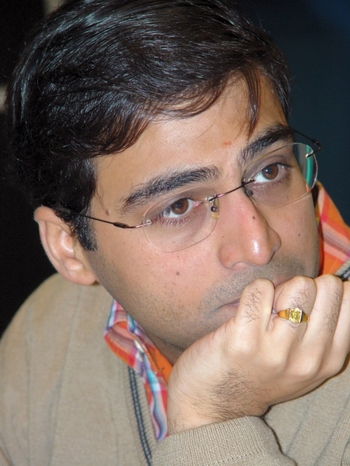
Vishy Anand
I think it was a very interesting match, if you look at the games, which were very combative. I think both sides were unable to get to any safe areas. We really had to fight; both sides missed a lot of opportunities. But I think that is a natural thing when both sides are taking a lot of chances and risks; you get a different kind of game than when you play something quite defensive. I accept that; I think it is especially in the first two days. I was able to score very heavily. When I won the 4th game, that meant that the match in all probability is almost over; very few people have come back from ½ - 3½.
BUT HE DID MAKE A COMEBACK?
Yes, he came back at one point, but in the end it was still a 2 point margin. So, as I said, I was able to win 2 games. I think he was able to cause me quite a few problems, just as I was causing problems to him as well. The first 4 games made all the difference because I was able to even afford 2 losses and still win the match back by 2 points. I think that in that sense the 4th game was really crucial.
Was his comeback because you didn’t use all your power because of the world championship preparation match or was that just what happened?
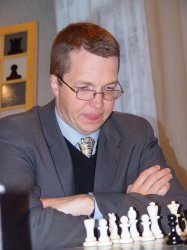
Alexander Grischuk
I think it just happened. Of course both sides are influenced by the score line; it probably cuts both ways, I would say. I think Argentina was not really a factor. I would say that, ok, after I got the 3 point lead, and I drew the 5th game, somehow in the 6th game something was wrong -- but it was clear that somehow I was to influenced by the score. But at the same time it was clear somehow that the 4th game was also very bad for him because he played very well but somehow I think the pressure of the score affected him. In a match you can not isolate yourself; you have got to isolate each game from the previous game. So you know the score and let’s say you have a certain amount of memory of how that match went and that affects you. Of course the last 4 games were influenced by that; I think that maybe the 8th game was a reversal of the 7th – that in the 7th that all I needed was a draw to go thru and win the tournament. Although I didn’t play for a draw I had already noticed
in the 6th game that this was a mistake. But in the 7th game I knew that at any moment I
could go for a draw or something like that. And in the 8th game my position was still winning but somehow when the match is over it is difficult to finish the job sometimes. There were a lot of mistakes and so on but I think that at least the chess was exciting.
That was a great event no doubt about it. Do you think that chess as a game and a profession has a future … taking into account the progress of chess computer programs?
I think, Yes, obviously computers have become incredibly strong, but I think that chess still has a future because people still want to see humans play each other and I think there is quite a lot to be discovered still in chess. Finally, I would say that I don’t believe that man versus machine is a topic that can be explored for some time. Obviously, now-adays the surprise would be if a human were to win, because finally a well played chess game is still a draw. So, I think that the human should at least be able to draw the machine, so it is not over yet, but every once in a while you get a match where the human loses pretty badly and people ask if the game is over, but ok the play is a bad day for Adams.
In this aspect how do you see the future or the present of the world championship …Do you think that a computer should participate in the world championship title?
No, I don’t think so, because I believe that when you play against a computer it is a totally different requirement. To give you an example, all humans are very influenced by the score, as I had mentioned in this match. A computer will start each game completely fresh; a computer has access to all these databases. There are a lot of these issues that have been dusted over in the past; I think simply because man versus machine offer a lot of money. But you do have to address these things. Whether it has database access or table access and I think unless, since man versus man and man versus machine are two completely different kinds of contest. I don’t believe they should play in the same events; they should be separate events.
Do you consider the forthcoming KO championship in Argentina to be a serious tournament worthy enough to be regarded as a world championship competition?
Yes I do, and it isn’t a KO, it is a Round Robin tournament. Yes, I think that, given the fact that I don’t know how many of the top 10 are going to be there, according to the July list [it is a bit messed up], according to an earlier list practically we are all listed in the top ten. I think that tells you something about the strength of an event when the best 8 players in the world get together that’s something, ok obviously Kramnik’s absence is a pity, but I don’t think [the absence of] one player takes away from the event.
What about the time control? [I talked to Karpov in New York way back a few years ago; he was not happy with the time control, the KO championship] If you’re happy with that, is it just because you are so good in rapid chess, or you’re not happy with the time control?
I am embarrassed, maybe I am, but I think that rapid chess is a good way to promote the game. I don’t see anything wrong with the 4 hour time controls so I had no particular objections against it, but I must say the 7 hour time control is what we will use in Argentina. Practically all the objections of many people have been addressed. It is not the KO it is the old slow time controls. In that sense Argentina will not be in the same mode.
Do you think that you can win the title as you performed in Teheran? Who, in your view, has good chances to become FIDE World Champion?
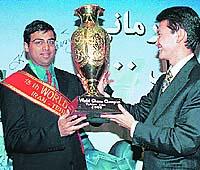
Vishy Anand (left) receives trophy in Teheran. Foto: Vahid Sahemi AP
I think that if I win as I did in Teheran, in New Delhi. Teheran I won without a single defeat, that’s going to be a tough one to repeat. I think I won almost all my many matches in that event. If it happens, great; but I am going with just hoping to score more points than the others, and that’s all. But if I can repeat anything like the New Delhi Teheran performance, that would be great.
We wish you good luck with that
Thank you
Let’s say you become a world champion, would you be interested in playing a reunification match? And, if your answer is Yes, then against whom?
Let’s put it this way: In theory all these possibilities sound interesting, but I am trying not to get ahead of myself. I think the main thing is to first win Argentina, keeping both feet on the ground, play Argentina – and then take it from there. After that, ok. If I win and there’re some interesting offers, then of course I would consider it. I prefer the response from a specific proposal rather than just a theoretical conversation.
How important is a reunification match to you? Which would be more important?: Anand-Kramnik or Anand-Kasparov?
As I said, First I think the main thing is to finish Argentina, playing that well, so at the moment for me the most important is: Anand against the 7 others in Argentina.
Was that fair that each time FIDE has given Kasparov the privilege of playing for the FIDE World Championship, without qualification? Actually Kasparov lost his title as far back as 1993 when he broke away from FIDE and played an unofficial match with Nigel Short.
Nigel Short
I think it’s history, that it was controversial, and that it created a lot of problems when he broke away in 1993. But as far as I’m concerned, I played a match against him in New York in 1993 under his rival association. I can’t say that this association was a bad idea. Actually they had quite a good candidate cycle in the world championship, but then they vanished after 3 years. I was unhappy with the privileges in Libya so I didn’t play, but, given the fact that Kasparov retired, somehow I feel this is irrelevant.
We all know that some months ago Kasparov made a statement that he withdraws from chess competitions. What stands behind his decision? Do you have any idea? Does he feel that he is getting weaker as a chess player and he will soon be unable to fight against the top players, or was it just his maneuver and he will soon come back to surprise the chess world?
It could be everything; I have no doubt that some of it at least is chess fatigue. It’s a constant grind. It’s also something, ok, either you accept it and do it unquestioningly, or, if you are asking every day, “Why am I doing this?”, it’s probably a good time to stop. I don’t think his retirement is final; I think he is keeping his cards open.
Do you imagine yourself withdrawing from chess and, like Kasparov, taking up politics in India?
At the moment I’m not thinking of anything like that, but I must say, One day I will retire from chess; but I definitely won’t go into politics. That’s a closed subject.
What do you think about Kasparov today, Kasparov as someone aspiring for the highest political position in Russia?
I don’t know, I think essentially he is interested in politics but I don’t know if he’s a marginal figure or where he stands in Russian politics. I don’t know a thing about that. Essentially at the moment it is pretty clear that he is not in the same league as Putin, but after a couple of years’ work, who knows what can change?
Lets go back to a question about time control. In a recent interview you mentioned some concerns about the upcoming FIDE world championship tournament and “time troubles”. So you have concerns about the imposed time control for this event or no?
Which one, in Argentina?
Yes in Argentina
No, not really. I think that the early suggestion I had the 4 hour time control to make it two time controls so one control will have additional time for 15 minutes bonus at the end, for additional time. Because it’s easier for playing game. I don’t know if Argentina has problem with the 4 hour control. There is a fair number of Grandmasters who are consistently arguing for the old slow control, 7 hours; I think at this time we’ll come back to that. In tournaments like Linares, Sophia we already played a 7 hour game. It’s not a new control, in that sense, it’s quite easy to adapt to.
Any changes foreseen in your personal strategy for this? Will you continue your trademark aggressive style, play the board or adjust for your respective opponents?
I think that generally it is better to stay true to yourself. But obviously you always take into account your opponent. I think the main thing is that in the process of confusing him you shouldn’t confuse yourself.
So go with the aggressive tactic?
Yeah, I play as always.
Personally, I love your style of play. There is something going on, on the board all the time.
Thank you
There were some observations that you appeared to be fatigued by the end of the Dortmund tournament… Was this the case and how might this impact you at the upcoming world championship?
Do you mean last year?
Yes last year
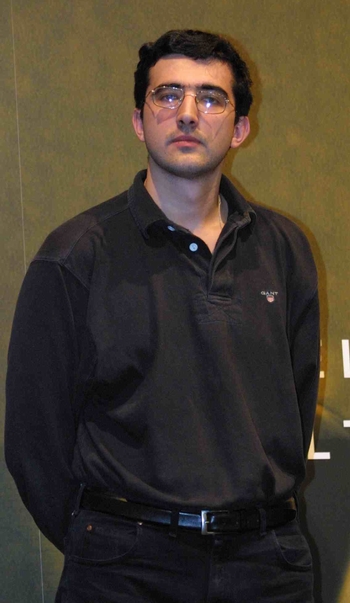
Wladimir
Kramnik
Last year, I don’t remember if I was tired but certainly the game with Kramnik, the first or second game [the main games] we made some mistakes, but I think for the positions early turn out it was much more complex than it looked. Both of us had the feeling like we were just waiting, but as we went along I would keep resisting as long as I could see moves. However, at the early stage white is winning and I had the same impression. But later on, I think when we checked it at home, it was next to impossible to find a win for white. So the position turned out to be much more complex than either of us had realized. The second game as well in reverse colors he had 1 up on his lead, but suddenly it proved very difficult to actually analyze this. This is well over a year ago, and a lot of things have happened since then before Argentina.
In 1995 you played a world championship match with Kasparov. At some point you were leading, what actually happened? Why did Kasparov win a string of games and you obviously broke down? Were there any psychological causes for your defeat? Chess causes? Or something totally outside the chess board?
I think basically that in a match there is a special type of tension and this is something you can only experience in a match -- especially the long ones. I would say the tenth game, because he found a big idea that broke my main defense with black, and I think this carried over to the next game with white as well. Two successive losses. After that I was able to stay a bit with one draw. Essentially my opening problems made me suddenly feel insecure and then things happened. I don’t know if this is very relevant to me now because I’m sure I’ve learned a lot over ten years.
If you had played a match with Kasparov in 2000, instead of Kramnik, would you have been able to dethrone Kasparov?
I think it is a saying, if your aunt was a man he would be my uncle.
How do you explain the fact that Kramnik’s performances are so disappointing and obviously there is not much hope that he would soon pull out and be the same Kramnik we knew five years ago?
I don’t know. He certainly remains a great player. He’s having a, lets say, he’s having
an erratic phase. At any moment he could snap out of it as well. Ok, I think I have to go down now.
Just 2 more questions please?
Ok
I would say 3 is that ok?
Ok, but very quickly
Who, in your view, regarding the younger generation is the most promising star?
Tremor
Radjabov
If you mean very young I would say Karijkan and Carlson. Slightly older I can include Radjabov.
What is the best way to present chess in the media, especially television … I would be particularly interested in your response for the sub-continent and Asia generally. Is it better to show high level players with complex commentary, or to present the game generally to people who can’t understand it, but like it?
I think that probably at times - get a lot of reports - I mean realistically getting whole game live especially these 7 hour ones is not achievable. So I think to get just a lot of participation and at times to get the media interested somewhat, at least a news report or a shot report about the thing and hopefully the word gets out that way.
Could you please tell us about your preparations for the world championship in Argentina and how many trainers do you have?
I will take some rest now and start my training basically; I tend to work with a lot of people.
How do you feel that your chess career has impacted you life as far as significant travel and time away from home, studying?
Obviously compared to a person who, Let’s say, has a job that does not require him to travel, my life is… ok. It may be a fair amount of travel, but frankly I can’t think of anything else to compare it with -- The chess life is all I know.
What do you think about the so-called Soviet Chess school? Did it really exist or is it just another fake cranked out by the Soviet communist to make an icon of their political regime?
No not at all, because it is reference to a movement, and that is what it was. There was never a building but there definitely was a movement. I think, yes, of course it had a profound impact on chess.
Thank you Sir have a wonderful day and we wish you good luck with the world championship
Ok, thank you have a nice day bye
You too.
(Special
thanks to Mrs. Anand) Hartmut Metz, My Special thanks to this man! He made this interview possible for us.
Special thanks to GM Sulypa, IM Jovan Petronic, Lev Khariton, James F. Holwell, Goran Urosevic, Anwar Qureshi, Phil Innes, Frank Kolasinski & Nikki.
Many thanks to Thilo Gubler for the pictures.


 Nachrichten
 Universität
 TopTurniere
 Chess960
 Unterhaltung
 Chess Classic
 Impressum